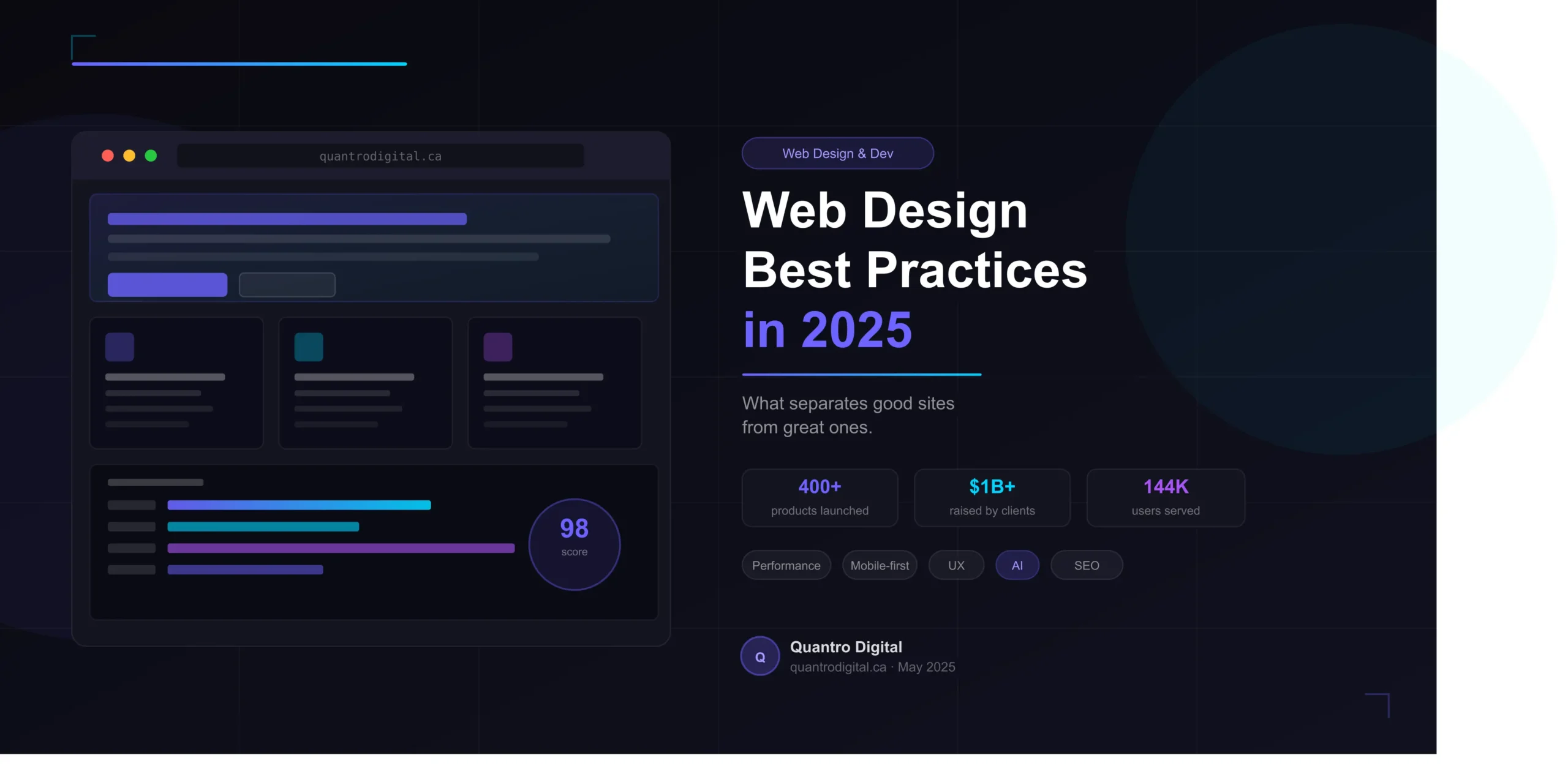
Your website is often the first impression a potential client has of your business. In 2025, that first impression happens in milliseconds, and the standards for what makes a site “good” have never been higher.
At Quantro Digital, we’ve launched over 400 digital products. Along the way, we’ve identified the patterns that separate high-performing websites from the ones that quietly bleed conversions. This post breaks down the web design principles we apply to every project, and why they matter for your business in 2025.
1. Performance Is the Foundation, Not a Feature
Speed is not a bonus, it’s a baseline. Google’s Core Web Vitals have made site performance a direct ranking factor, and users expect pages to load in under 2 seconds. Anything slower and bounce rates climb sharply.
What this looks like in practice:
- Optimized images served in next-gen formats (WebP, AVIF)
- Lazy loading for off-screen content
- Minimal third-party scripts and lean code output
- CDN delivery and edge caching
When we rebuilt ENT Specialists’ website, performance optimization alone contributed to a 34,000+ monthly visitor increase. The site had the right content before, it just wasn’t fast enough to rank.
2. Design for Clarity, Not Complexity
The most effective websites in 2025 are not the most visually elaborate, they’re the clearest. Visitors should understand what you do, who you serve, and what to do next within seconds of landing on your homepage.
This means ruthless hierarchy: one primary CTA per section, headlines that speak to outcomes rather than features, and whitespace used deliberately rather than as filler. Visual complexity is often a symptom of unclear strategy.
A simple test: show your homepage to someone unfamiliar with your business for five seconds. Can they tell you what you do and who you help? If not, the design is working against you.
3. Mobile-First Is Non-Negotiable
Over 60% of web traffic now comes from mobile devices. Designing for desktop first and “making it work” on mobile is a recipe for a broken user experience. In 2025, mobile-first isn’t a philosophy, it’s a technical requirement.
This means designing for touch interactions from the start, ensuring tap targets are appropriately sized, and ensuring navigation works intuitively on a small screen. Responsive frameworks help, but they don’t replace intentional mobile design decisions made early in the process.
4. Accessibility Expands Your Audience
Web accessibility (WCAG compliance) is often treated as a legal checkbox, but it’s really a quality indicator. Sites built accessibly tend to have better semantic structure, cleaner code, and stronger SEO, because the same practices that help screen readers help search engine crawlers.
Key practices include:
- Sufficient colour contrast ratios (minimum 4.5:1 for normal text)
- Descriptive alt text on all meaningful images
- Keyboard-navigable interfaces
- ARIA labels where needed for dynamic content
5. AI Is Changing How Websites Work: Not Just How They Look
2025 has firmly established AI as a functional layer within websites, not just a marketing talking point. The highest-converting sites we build today include AI-powered chat agents, dynamic personalization, and automated lead qualification, all embedded into the design seamlessly.
The key is integration without friction. An AI chat agent that feels bolted-on creates distrust. One that matches your brand tone, understands your services, and guides visitors toward the right action feels like a natural part of the experience.
This is an area where having a development partner who understands both design and AI systems, not just one or the other, makes a significant difference in the final product.
6. Your Website Is a System, Not a Brochure
The most significant mindset shift we bring to every engagement is this: a website is not a static brochure you update once a year. It’s a living system connected to your CRM, analytics, automation workflows, and customer journey.
When Puffin Vape needed to scale nationally, they didn’t just need a better-looking site, they needed a connected eCommerce system with inventory management, conversion-optimized product pages, and SEO infrastructure built in from day one. The result was 5,000+ new customers acquired and nationwide shipping capability.
A website that doesn’t connect to the rest of your business systems is leaving growth on the table.
Build for Where Your Business Is Going, Not Where It Is
The businesses that outgrow their industries don’t just have nice websites, they have digital infrastructure designed to scale. Every decision, from page speed to CTA placement to AI integration, is made in service of a specific business outcome.
If your current website isn’t doing that work for you, it’s time to change it.
Ready to build something that compounds your growth? Book a free strategy call with Quantro Digital at quantrodigital.ca.