Your homepage gets a few seconds to answer three questions: what do you do, is it for me, and what should I do next? If visitors can’t find those answers almost instantly, they leave, no matter how good your design looks. That’s why homepage copy, the actual words on the page, matters more than most business owners realise.
The good news is you don’t need to be a professional copywriter to improve it. This guide walks through how to write homepage copy that’s clear, persuasive, and genuinely helpful, section by section.
We write and build homepages like this as part of every Calgary web development and Edmonton web development project, at fixed prices.
Why homepage copy matters so much
For many businesses, the homepage is the most visited page on the site. It’s where people land from your Google Business Profile, social media, printed materials, and word-of-mouth referrals. Those visitors arrive with very different questions, and your homepage copy has to guide each of them to the right place.
People don’t read websites word by word. Research from the Nielsen Norman Group has shown for years that people scan. They look at headings, the first words of paragraphs, buttons, and anything that stands out. Good homepage copy is written for scanners first and readers second.
The most common homepage copy problems
- Vague headlines. “Innovative solutions for tomorrow” could describe almost any business on earth.
- Talking about yourself, not the customer. “We are a leading provider” is less compelling than “Get your furnace fixed today”.
- Jargon. Industry terms that feel normal to you can confuse customers.
- No clear next step. Visitors should never wonder what to click.
- Everything at once. Listing every service in equal detail makes nothing stand out.
Gather your raw material first
The hardest part of writing is usually the blank page. Before you draft anything, collect material you already have. Read through your best customer reviews and note the words people use to describe you, because those phrases often make better headlines than anything invented in a meeting. Ask your front desk or sales team what questions new customers ask most. List the three things competitors can’t claim that you can. Pull a few numbers, like jobs completed, years in business, or average response time. With this in front of you, the writing becomes a matter of arranging good ingredients rather than inventing them from nothing. It also keeps the language grounded in how real customers talk, which makes the finished page feel more natural and trustworthy.
How to write homepage copy, section by section
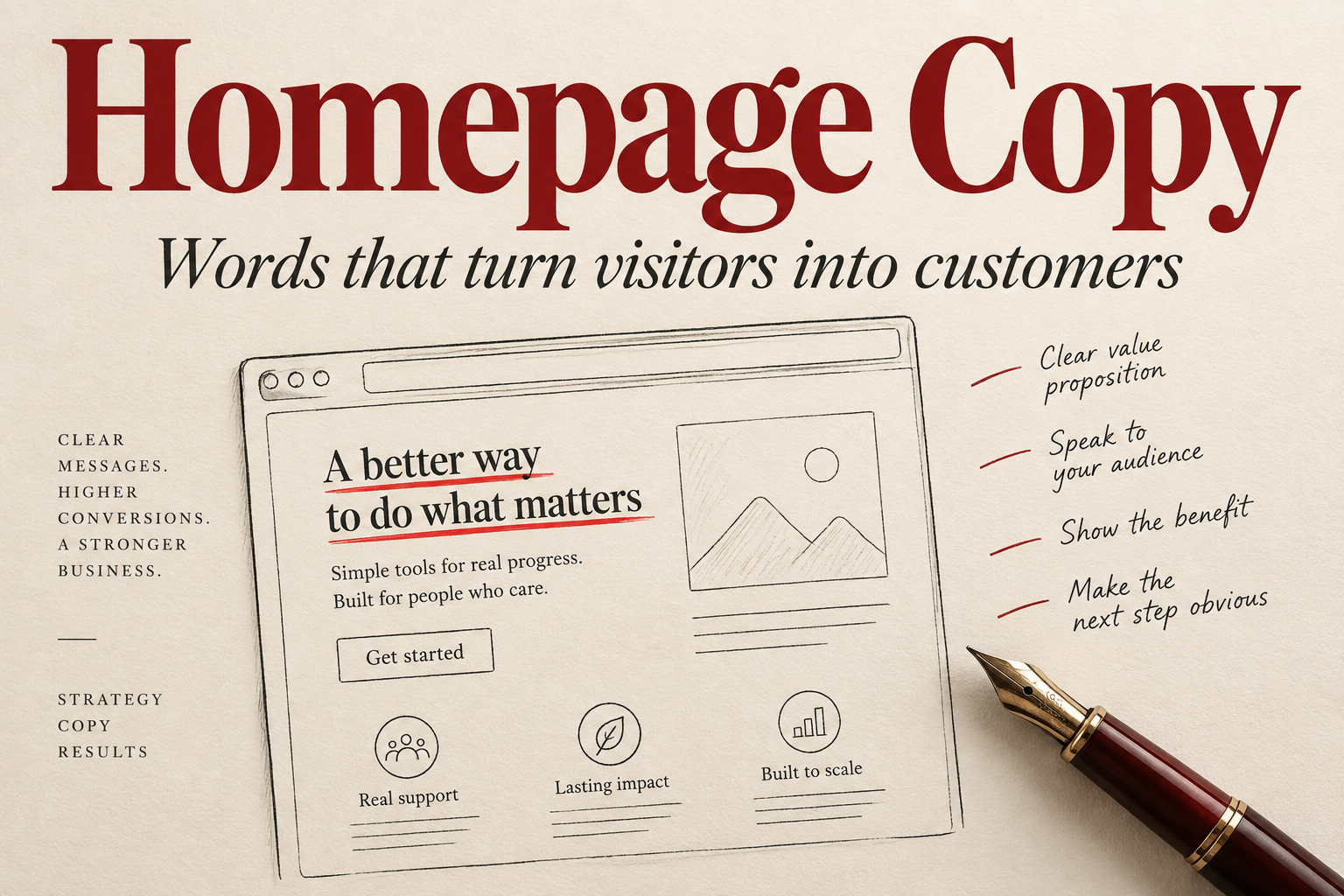
The headline
Your headline should say what you do and who you do it for, in plain words. “Bookkeeping and payroll for Alberta small businesses” beats “Your financial partner” every time. If you can add the main benefit, even better: “Accurate books every month, so tax season is stress-free.”
The subheadline
Use one or two sentences to add detail: what makes you different, where you work, or what customers can expect. This is where you answer “why you and not the next business?”
The primary call to action
Place a clear button near the top with specific wording: “Book a free consultation”, “Get a quote”, or “Shop bestsellers”. Offer a secondary option, like a phone number, for people who prefer to call.
Trust signals
Right below the top section, show proof: a review rating, client logos, years in business, certifications, or a short testimonial. First-time visitors need a reason to believe you before they’ll keep reading.
Services or products
Summarise your main offerings in short, scannable blocks. Each block should have a clear heading, one or two sentences on the benefit, and a link to a dedicated page with more detail. Keep your homepage copy here brief and let service pages do the heavy lifting.
How it works
A simple three- or four-step process reduces uncertainty. For example: book a call, get a plan, we do the work, you see the results. People are more likely to act when they can picture what happens next.
Why choose you
This is where you address the real reasons people hesitate. Price transparency, response time, guarantees, local presence, experience in their industry. Be specific. “We reply within one business hour” is stronger than “great customer service”.
Social proof
Share two or three testimonials with real names and specifics, or short case studies with results. A testimonial that mentions a problem and an outcome is far more persuasive than “Great to work with!”
A closing call to action
End with another clear invitation to take the next step, for visitors who’ve read to the bottom and are now ready.
9 tips for homepage copy that converts
- Write like you talk. Read your homepage copy out loud. If it sounds stiff, rewrite it.
- Lead with the customer’s problem. Show that you understand what they’re dealing with.
- Use “you” more than “we”. Keep the focus on the visitor.
- Be specific. Numbers, places, timelines, and examples build credibility.
- Keep paragraphs short. Two or three sentences at most, especially on mobile.
- Use descriptive headings. Someone skimming only the headings should still understand your offer.
- Cut filler words. “Very”, “really”, and “high-quality” rarely add meaning.
- Repeat the call to action. After each major section, give people a way to act.
- Test it on real people. Show the page to someone outside your business for five seconds and ask what you do.
Before and after: a simple rewrite
Here’s what this looks like in practice for a fictional landscaping company in Ottawa.
Before: “Welcome to GreenLeaf. We are a premier, full-service outdoor solutions provider committed to excellence. Our passionate team delivers innovative results that exceed expectations.”
It sounds professional, but it says almost nothing. What do they actually do? Where? For whom? Why should anyone care?
After: “Landscaping and lawn care for Ottawa homeowners. Weekly mowing, spring clean-ups, and new gardens, done on schedule by a local crew with over 300 five-star reviews. Get a free quote within 24 hours.”
The second version tells visitors exactly what’s offered, confirms they’re in the right place, gives a reason to trust the business, and points to a clear next step. It’s also shorter. Good homepage copy is usually simpler than people expect.
Write for phones first
Most visitors will read your homepage on a phone, where only a headline, a sentence, and a button fit on the first screen. That means your most important message has to come first, not after a large image or a slider. Keep headlines short enough to fit on two or three lines on a small screen. Break long sections into bite-sized pieces. Make buttons large and easy to tap, and make your phone number tappable too. When you review drafts, look at them on an actual phone before you approve anything.
Add personality without losing clarity
Clear doesn’t have to mean boring. Once the basics are covered, let your personality show in the details: the way you describe your team, the stories in your testimonials, a little warmth or humour in section introductions. A family-run bakery can sound cozy and welcoming. A cybersecurity firm can sound calm and precise. The rule is simple: be clear first, then add character. Never trade clarity for cleverness in the headline.
A quick homepage review checklist
- A stranger can explain what you do after five seconds
- The headline names your service and your customer
- A clear call to action appears without scrolling on mobile
- Proof, like reviews or client logos, appears near the top
- Each main service links to its own detailed page
- Paragraphs are short and headings are descriptive
- Contact details are easy to find and tap on a phone
- The page reads naturally when spoken out loud
If you can tick every item, your homepage copy is in better shape than most. If not, pick the two biggest gaps and start there.
Homepage copy and SEO
Your homepage usually ranks for your brand name and your main service. Include your primary service and location naturally in the headline or subheadline, use clear headings, and link to your key service pages. Well-structured homepage copy also helps AI tools understand and describe your business accurately, which we explain in our guide to AI search optimization. Just don’t stuff keywords in at the expense of clarity. Write for people first.
Homepage vs landing page
A homepage serves many audiences and points in several directions. A landing page serves one audience with one offer. If you’re running ads, send that traffic to focused landing pages rather than your homepage. Our post on landing page mistakes explains why.
Homepage copy FAQ
How long should homepage copy be?
Long enough to explain what you do, prove you’re credible, and guide people to the next step. For most small businesses, that’s a few hundred words spread across clear sections, with details on linked pages.
Should I hire a copywriter?
If your website drives a lot of business, a professional can be worth it. Either way, you know your customers best, so be closely involved.
How often should I update my homepage?
Review it at least once a year, and whenever your services, pricing, or target customers change.
Is your homepage doing its job?
We’ll review your homepage copy and layout, and show you exactly what to change to turn more visitors into enquiries.