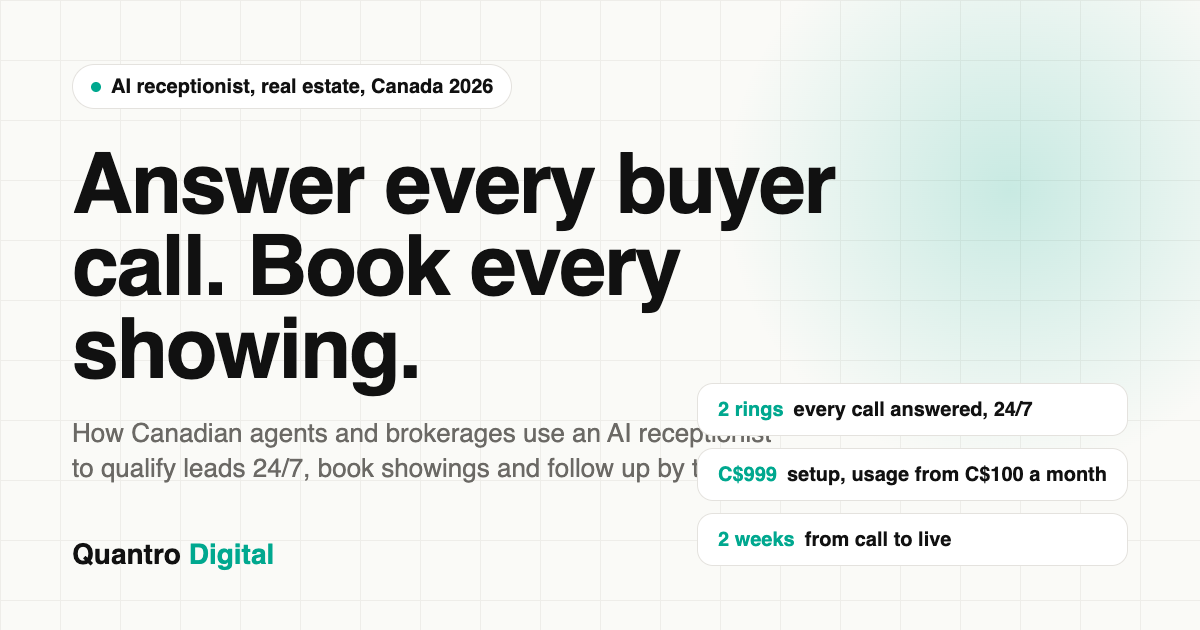
A buyer drives past your sign on a Sunday afternoon, calls the number, gets voicemail and calls the next sign on the street. That is how most real estate leads are lost in Canada, not to a better agent but to a faster one. An AI receptionist for real estate answers that call in two rings, finds out what the caller wants, books the showing and texts both of you the details before the buyer has pulled away from the curb. This guide explains what it does, what it costs, how it fits Canadian real estate rules, and how agents and brokerages set it up.
Why speed decides who gets the client
The best known research on lead response, a study of over a million sales calls by Dr. James Oldroyd published through MIT and InsideSales, found that contacting a lead within five minutes made the lead far more likely to be qualified than waiting even thirty minutes, and that most companies take hours. Real estate is worse than most industries because agents are on the road, in showings and in negotiations when the phone rings. In the brokerages we work with, 30 to 45 percent of inbound calls go to voicemail, and most of those callers never leave a message.
Every missed call is a buyer who wants a showing, a seller testing whether you pick up before they list with you, a tenant for a rental, or a referral from a past client. At an average Canadian commission of several thousand dollars per side, you only need to recover one lost deal a year for an AI receptionist to pay for itself many times over. Our AI receptionist ROI calculator runs your own numbers.
What an AI receptionist does for an agent or brokerage
| Call type | What the AI does | What you get |
|---|---|---|
| Sign call about a listing | Confirms which property, shares approved details such as price, bedrooms and open house times, offers a showing | A booked showing with the buyer’s name, number and timeline |
| Buyer from a portal or ad | Asks budget, pre-approval status, areas, timeline and whether they are working with an agent | A qualified lead in your CRM with a summary and a booked consultation |
| Seller inquiry | Captures the address, timeline and reason for selling, books a listing appointment | A listing appointment on your calendar within minutes of the call |
| Rental inquiry | Checks availability, screens basic criteria, books a viewing or sends the application link | Fewer interruptions and only qualified viewings |
| Existing client | Recognizes the number, takes the message or transfers to you if urgent | Clients feel looked after even when you are busy |
| Vendors, spam and solicitation | Screens politely and ends the call | Zero wasted time |
Seven things to look for
- Answers in two rings, 24/7, in English and French. The point is to never miss a call, including the Sunday afternoon ones.
- Reads your listings. It should answer factual questions from an approved listing sheet, not make things up.
- Books directly into your calendar and respects buffers, showing windows and team round robin rules.
- Texts the caller immediately with the confirmation, your contact card and a link to the listing.
- Transfers live when it matters. A pre-approved buyer ready to see a property today should reach a human.
- Logs everything to your CRM with a transcript, a summary and tags such as buyer, seller, hot, warm.
- Follows your compliance rules. No advice on offers or pricing, clear disclosure that it is an assistant, and consent captured before marketing texts.
The Canadian rules, in plain language
Three sets of rules matter. First, your provincial regulator, such as RECA in Alberta, RECO in Ontario, BCFSA in British Columbia, the OACIQ in Quebec and their equivalents elsewhere, licenses people, not software. The AI can schedule, collect information and share approved listing facts, but anything that looks like advice, negotiation or representation goes to a licensed agent. Second, CREA’s REALTOR Code and your brokerage policies on advertising and disclosure, which is why the assistant should identify itself and your brokerage. Third, CASL, Canada’s anti-spam law: a caller who asks about a listing gives implied consent for follow up related to that inquiry, but ongoing marketing texts need express consent, which the assistant can ask for and record. PIPEDA and provincial privacy laws apply to the call recordings and transcripts, so choose a provider that stores data in Canada and lets you delete it.
What it costs in Canada
| Option | Monthly cost | Covers | Books showings |
|---|---|---|---|
| Voicemail | C$0 | Nothing | No |
| Shared brokerage reception | Included, weekdays | 9 to 5 | Sometimes, by message |
| Answering service | C$150 to C$600 | 24/7, message taking | Rarely |
| Part time assistant | C$2,100 to C$2,600 | 20 hours a week | Yes |
| Quantro AI receptionist | C$100 to C$500, plus C$999 setup | 24/7, unlimited simultaneous calls | Yes, into your calendar |
Pricing is usage based, so a solo agent handling 150 calls a month pays far less than a 40 agent brokerage. There is no per seat fee and no long contract. See the full breakdown in our AI receptionist cost guide.
A worked example: a two agent team in Calgary
A two agent team receives about 60 calls a week and misses a third of them, mostly evenings and weekends. Roughly half of the missed calls are new buyers or sellers. With a 10 percent close rate and an average commission of C$6,000 per side, the team is losing about C$5,600 a month in commissions that go to whoever answered next. An AI receptionist at C$249 a month that recovers 90 percent of those calls returns more than 20 times its cost, and the setup pays for itself in the first week. Change the numbers to yours in the calculator.
How setup works
- Discovery call. We map your call types, your team’s calendars, your CRM and your compliance rules.
- Scripts and knowledge. We write the greetings, qualifying questions and transfer rules, and load an approved listing sheet and FAQ.
- Integrations. Calendar, CRM, texting and your listing feed are connected and tested.
- Test calls. You and your team call it with real scenarios until it sounds right.
- Go live. Forward your number always, after hours only, or on no answer. Most teams start with after hours and switch to always within a month.
- Monthly review. We read the transcripts, tune the scripts and add new listings and FAQs.
Mistakes to avoid
- Letting the AI quote prices or opinions that are not on the approved listing sheet.
- Forwarding only when busy and forgetting to forward after hours, which is where most missed calls are.
- Not connecting the CRM, so leads live in a transcript nobody reads.
- Choosing a US only provider that stores recordings outside Canada without telling clients.
- Skipping the monthly review. Scripts that were right in spring are wrong during a fall listing rush.
Frequently asked questions
What does an AI receptionist for real estate actually do?
It answers every inbound call in two rings, 24 hours a day, identifies whether the caller is a buyer, seller, tenant or vendor, asks the qualifying questions you set, books showings and consultations into your calendar, texts the caller a confirmation and pushes the full transcript and summary into your CRM. Hot leads can be transferred to you live.
How much does it cost in Canada?
With Quantro, setup is C$999 one time and usage starts at C$100 a month. A busy solo agent typically pays C$149 to C$249 a month, a team or brokerage C$349 to C$799 depending on call volume. Compare that with C$2,100 or more a month for a part time receptionist who still misses evenings and weekends.
Will buyers know they are talking to an AI?
Yes. It introduces itself as your assistant, which is the honest approach and what regulators expect. Callers care about being answered immediately and getting a showing booked; most prefer a helpful AI to voicemail.
Is it allowed under real estate rules in my province?
Yes, as long as it does not give advice or negotiate. It collects information, books appointments and shares factual listing details you approve. Anything about offers, pricing strategy or contract terms is transferred to a licensed agent. We set those rules with you before launch and follow CREA’s code and your provincial regulator’s advertising rules.
Does it work with my CRM and showing tools?
It connects to Follow Up Boss, kvCORE, Lofty, GoHighLevel, HubSpot, Google Calendar, Calendly and most systems with an API, and it can read an approved listing sheet so it answers questions about price, bedrooms and open house times accurately.
How long does setup take?
About two weeks. We script the call flows, load your listings and FAQs, connect the calendar and CRM, test with real calls, then forward your number when you are ready: always, after hours only, or only when you do not pick up.
Stop losing Sunday afternoon buyers
Quantro Digital builds AI receptionists for Canadian agents, teams and brokerages, live in about two weeks, with setup at C$999 and usage from C$100 a month. Book a free strategy call and we will send you a demo number you can call today. Related guides: how much missed calls cost, AI receptionists for law firms and lead follow up automation.
Sources: Oldroyd, J., The Lead Response Management Study (MIT and InsideSales.com); CRTC, Canada’s Anti-Spam Legislation; Canadian Real Estate Association. Checked October 2026.