
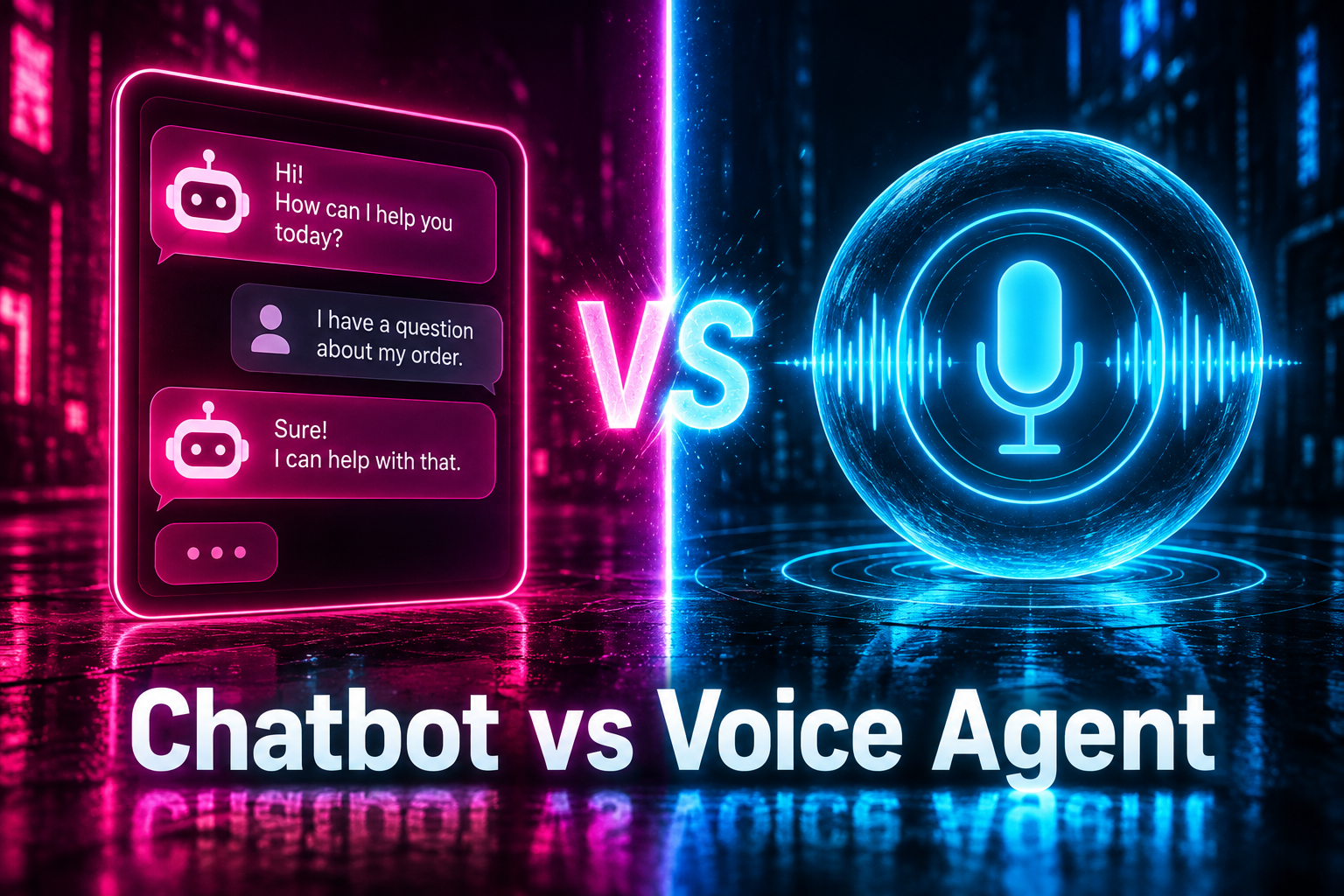
Every business wants to answer customers faster, but not every business needs the same tool to do it. The AI chatbot vs voice agent question comes up in almost every conversation we have about automation, and the honest answer is that it depends on how your customers actually reach you. A dentist whose patients phone in has different needs from an online store whose shoppers live in a chat window.
This guide explains what each tool does well, where each one struggles, and how to decide without getting lost in buzzwords.
What an AI chatbot does
An AI chatbot is a text-based assistant that lives on your website, in Messenger, WhatsApp, Instagram, or SMS. Modern ones understand plain questions, pull answers from your own content, collect contact details, and hand the conversation to a person when needed.
An AI chatbot works best when:
- Your visitors are already on your website and have quick questions about pricing, hours, shipping, or services.
- You want to capture leads outside business hours.
- Answers are easy to check in writing, like order status or product specs.
- You get a lot of repeat questions that eat up support time.
What an AI voice agent does
A voice agent answers and makes phone calls in a natural spoken voice. It can greet callers, ask the right questions, book appointments, send a text confirmation, and pass urgent calls to a human. If you’d like to see what’s behind the scenes, our voice orb implementation guide walks through one approach.
Voice agents work best when:
- Your customers prefer to call, which is common for trades, clinics, salons, restaurants, and legal or financial services.
- Missed calls cost you real money.
- The task follows a clear script, such as booking, rescheduling, or qualifying a lead.
- Callers are often busy, driving, or on the job site and don’t want to type.
AI chatbot vs voice agent: a side-by-side view
Customer habits
This is the most important factor. Look at how customers contact you today. If most inquiries come through your website form or chat, start with an AI chatbot. If your phone rings all day, a voice agent will have more impact.
Complexity of the conversation
Text gives people time to think and lets you show links, images, and buttons. Voice is faster for simple back-and-forth but harder for anything with lots of detail, like a long address or an email spelled out. Good voice agents are designed around short, clear exchanges.
Setup effort
Both need good source material. A chatbot needs accurate written content to draw from. A voice agent needs that plus carefully written call flows, tone, and fallback rules. Voice takes more testing because people interrupt, mumble, and go off script.
Cost and scale
An AI chatbot is usually cheaper to run per conversation. Voice agents cost more per interaction but replace something even more expensive: a missed call, or a receptionist tied up on routine questions.
Trust and tone
Some customers are happy to talk to an AI as long as it’s helpful. Others want a person. In both cases, be upfront that it’s an AI assistant and make the route to a human easy to find.
When you need both
Many businesses end up with both, connected to the same brain. A customer chats on your site at 9 p.m., then calls the next morning, and the system already knows who they are and what they asked. That kind of connected setup is where the real time savings show up. It also feeds your CRM automatically, so your team follows up with context instead of starting from scratch. Our AI agents and voice solutions are built this way, and our complete guide to AI agents for Canadian businesses goes deeper on the strategy.
Real examples by industry
The right choice gets clearer when you look at how specific businesses use these tools day to day.
Clinics and health practices
Patients tend to call. They want to book, move an appointment, or ask whether a treatment is covered. A voice agent that answers every call, books into your scheduling system, and sends a text reminder can take a lot of pressure off the front desk. An AI chatbot on the website still helps with new patient forms and common questions after hours. We cover this in more depth in our post on AI agents for healthcare in Canada.
Trades and home services
Plumbers, electricians, and roofers lose jobs every time a call goes to voicemail, because the customer just calls the next company on the list. A voice agent that picks up, asks about the problem, collects the address, and books a visit is often the single most valuable automation for these businesses.
Online stores
E-commerce customers are already on the website, often late at night. An AI chatbot that answers sizing questions, tracks orders, and explains return policies fits naturally. Phone calls are rarer, so voice is usually a lower priority.
Real estate and professional services
Leads come from everywhere: listing sites, social media, the website, and the phone. Here a combined setup shines. The AI chatbot qualifies website visitors, the voice agent handles inbound calls and follow-ups, and both push every lead into the same CRM.
What a good AI chatbot needs before launch
The tool itself is rarely the hard part. The preparation is. Before launching an AI chatbot, make sure you have:
- Accurate source content. Up-to-date service pages, pricing, policies, and FAQs. The AI chatbot can only be as good as what it learns from.
- A clear handoff. A simple way to reach a person, whether that’s live chat, a callback request, or an email.
- Boundaries. Topics it should never answer, like medical or legal advice, and wording for politely declining.
- Lead capture. A natural point in the conversation to ask for a name and contact details, sent straight to your CRM.
What a good voice agent needs before launch
Voice needs everything above, plus a few extras. Write call flows for your most common scenarios. Decide which calls must go straight to a person, such as emergencies or upset customers. Choose a voice and tone that match your brand. Then test it with real people who haven’t seen the script, because they’ll say things you never expected. Plan for a week or two of listening to recordings and tightening responses before you rely on it fully.
How to measure whether it’s working
Pick a few numbers before launch so you can judge results honestly:
- Percentage of conversations resolved without a person stepping in
- Appointments or leads captured per week
- Missed calls before and after
- Average response time to new inquiries
- Customer feedback or satisfaction ratings
If your AI chatbot answers plenty of questions but books nothing, it may need a clearer call to action. If a voice agent keeps transferring calls, its scripts probably need work.
AI chatbot and voice agent FAQ
Will an AI chatbot replace my staff?
In most small businesses, no. It takes over repetitive questions and after-hours inquiries so your team can focus on work that needs a human touch. Our article on how AI is changing admin work in Canada looks at this in more detail.
Can a voice agent speak French?
Yes. Modern voice agents can handle English and French, which matters for businesses in Quebec, New Brunswick, and anywhere with bilingual customers.
How long does setup take?
A focused AI chatbot can be live in a couple of weeks. A voice agent connected to your calendar and CRM usually takes a little longer because of testing.
What each option typically costs
Pricing varies a lot depending on how much the tool needs to do, but the cost structure is fairly predictable. Most setups have three parts.
- Setup and build. Writing the knowledge base, designing conversation flows, connecting your calendar and CRM, and testing. This is a one-time cost and it’s where quality is decided.
- Platform and usage fees. Chat is usually billed per conversation or per message, while voice is billed per minute of talk time. Voice minutes cost more than chat messages, so call volume matters when you budget.
- Ongoing tuning. Reviewing transcripts, updating answers when your prices or services change, and adding new scenarios. A few hours a month keeps things sharp.
The fair comparison isn’t the tool against zero. It’s the tool against what the work costs today: staff time spent answering the same questions, overtime at the front desk, or leads that never get a reply. For many businesses, even a modest number of recovered calls or bookings covers the monthly bill. Start with the channel that has the most obvious gap, prove the value, and expand from there.
Privacy and compliance in Canada
Anything that collects names, phone numbers, or health or financial details needs care. Canada’s federal privacy law, PIPEDA, and provincial rules like Quebec’s Law 25 shape what you can collect and how you must explain it. Tell people what you collect, why, and how long you keep it. If you handle call recordings or patient information, get proper advice before launch.
How to choose in three steps
- Count your contact channels. Check a month of data: calls, form fills, chats, emails. Follow the volume.
- Pick one high-value job. Booking appointments, qualifying leads, or answering the top ten questions. Don’t try to automate everything at once.
- Test with real customers. Start small, read the transcripts, and improve weekly.
If you’re unsure where you stand, our AI readiness scorecard is a quick way to see which processes are ready to automate.
Not sure whether chat or voice fits your business?
Book a free strategy call. We’ll look at how your customers reach you and recommend a practical starting point.
One Response