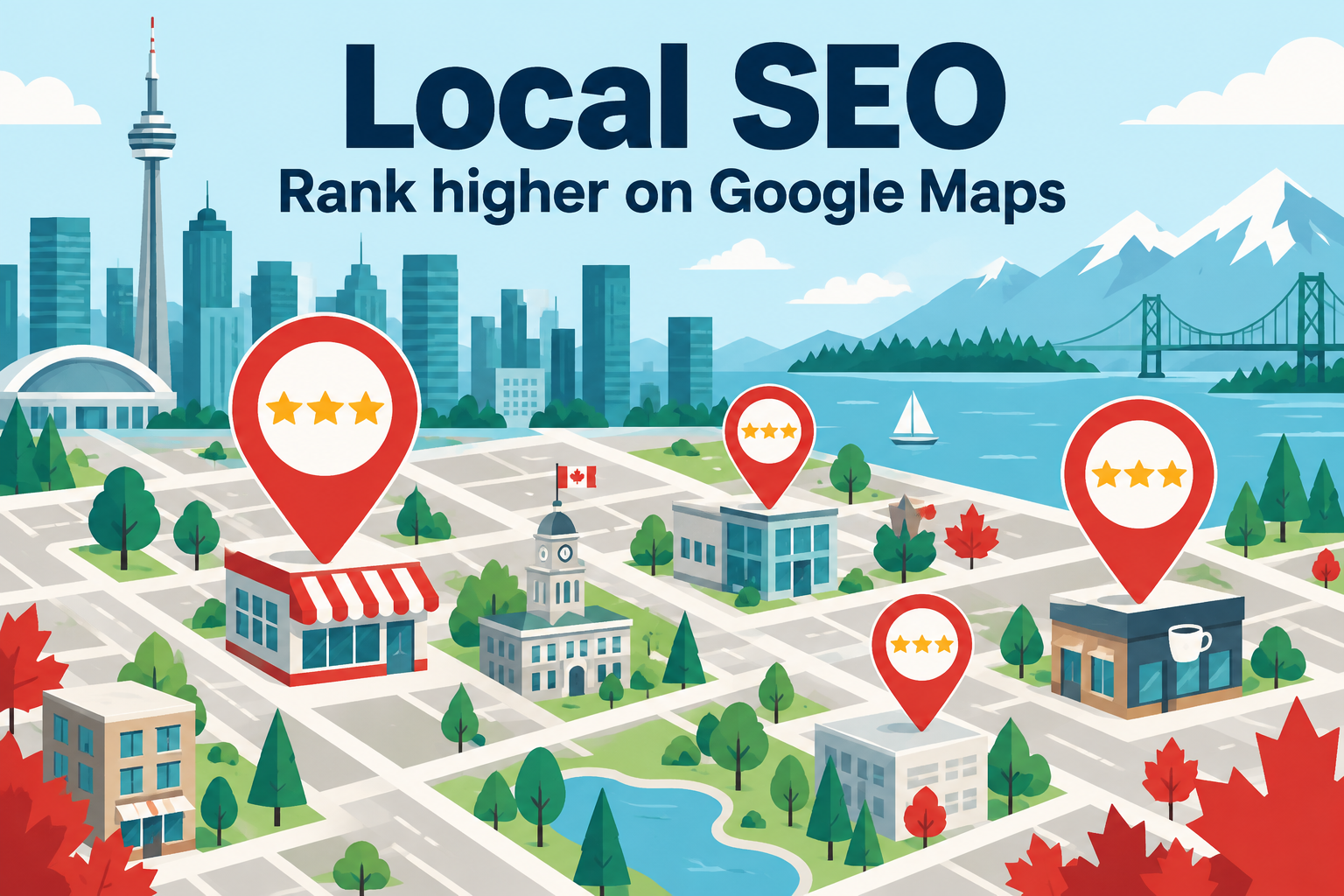
When someone nearby searches for “plumber near me” or “best physio in Calgary”, Google shows a map with three businesses before any regular results. That little box is called the local pack, and for many service businesses it brings in more calls than the website itself. The key to getting there is your Google Business Profile, and local SEO for small businesses starts with setting it up properly.
The good news is that most of this is free. It just takes a bit of care and some consistency.
How local SEO rankings work
Google says local results are based mainly on three things: relevance, distance, and prominence. You can read the details in Google’s own explanation. In plain terms:
- Relevance is how well your profile matches what the person searched for.
- Distance is how close you are to the searcher. You can’t change this, so don’t try to game it.
- Prominence is how well known and trusted you are, based on reviews, links, mentions, and your overall web presence.
You control relevance and prominence. That’s where your local SEO effort should go.
Set up your Google Business Profile the right way
Choose the right primary category
Your primary category has a big effect on which searches you show up for. Be specific. “Emergency plumber” or “Family dentist” beats a vague parent category. Add a few secondary categories for other services you genuinely offer.
Keep your name, address, and phone consistent
Use your real business name, without stuffing extra keywords into it. Make sure your address and phone number match exactly across your website, your profile, and directories like Yelp, Yellow Pages, and industry listings. Small differences confuse search engines.
Fill in every section
Hours, holiday hours, services, service areas, products, attributes, and a proper business description. A complete profile gives Google more to work with and gives customers fewer reasons to look elsewhere.
Add real photos regularly
Photos of your team, your storefront, your work, and your vehicles make your profile feel alive. Skip the stock images. A new photo every couple of weeks is a good habit.
Reviews: the engine of local SEO for small businesses
Reviews influence both your ranking and whether people actually call. A few practical habits help:
- Ask every happy customer, ideally right after the job is done. A short text with a direct review link works well.
- Reply to every review, good or bad. Keep replies human and specific.
- Handle negative reviews calmly. Acknowledge the problem and offer to fix it offline. Future customers read your reply more closely than the complaint.
- Never buy reviews or offer rewards for five stars. It breaks Google’s rules and can get reviews removed.
If asking for reviews keeps slipping through the cracks, it’s a perfect job for automation. Our CRM and revenue automation setups send review requests automatically after each appointment or sale.
Make your website back up your profile
For strong local SEO, your Google Business Profile and your website work as a team. Google looks at both.
Build a page for each main service
One page that lists everything you do is hard to rank. A separate page for each core service, with real detail, works far better.
Create location pages carefully
If you serve several cities, a page for each can help, but only if each one is genuinely useful. Mention local projects, landmarks, or service details. Copying the same page and swapping the city name rarely works anymore. You can see how we approach this on our pages for Edmonton and Vancouver.
Make it fast and mobile friendly
Most local searches happen on phones, often when someone needs help right now. A slow site loses those people fast.
Local citations and directory listings
A citation is any mention of your business name, address, and phone number on another website. Citations help Google confirm that you’re a real, established business in a specific place. For Canadian businesses, the useful ones usually include Yelp, YellowPages.ca, Canada411, the Better Business Bureau, your local chamber of commerce, and directories specific to your industry, like HomeStars for trades or RateMDs for clinics.
You don’t need hundreds. A few dozen accurate, relevant listings beat a pile of low-quality ones. The most important local SEO task here is consistency. If you’ve moved or changed phone numbers in the past, hunt down the old listings and update them.
Local SEO for service-area businesses
If you visit customers rather than having them come to you, like a mobile dog groomer or a landscaping company, you can hide your street address on your Google Business Profile and list the areas you serve instead. Keep the list realistic. Claiming an entire province rarely helps, and Google still weighs where your business is actually based.
Avoid virtual offices and mailbox addresses set up just to appear in another city. Google’s guidelines don’t allow them, and profiles using them can be suspended. Honest local SEO is slower, but it doesn’t disappear overnight.
Local content that actually helps
Blog posts that exist only to repeat a city name don’t do much. Content that genuinely helps local customers does. A few ideas that work well for local SEO:
- Project write-ups with photos, such as “Basement renovation in Sherwood Park”
- Seasonal guides, like preparing your furnace before a Calgary winter
- Answers to questions customers in your area ask, including local permits, bylaws, or rebates
- Pages about community work, sponsorships, or partnerships with other local businesses
This kind of content earns links and mentions from local sites, which feeds straight back into prominence.
Local SEO mistakes to avoid
- Stuffing keywords into your business name. “Smith Plumbing Toronto Best Emergency Plumber” can get your profile suspended.
- Creating duplicate profiles. One location, one profile. Duplicates split your reviews and confuse Google.
- Ignoring the profile after setup. Old hours and a two-year-old photo gallery tell customers you might not be around anymore.
- Buying reviews or links. It’s against the rules and it’s usually easy to spot.
- Leaving reviews unanswered. Silence, especially on negative reviews, is a missed chance to show how you treat people.
A simple 30-day local SEO plan
If all of this feels like a lot, break it into weeks. Here’s a realistic month for a busy owner.
Week 1: fix the foundations
Claim or verify your Google Business Profile. Choose the most accurate primary category, fill in every field, and correct your hours. Make sure your business name, address, and phone number match your website exactly.
Week 2: photos and reviews
Upload ten to fifteen real photos of your team, your space, and your work. Then set up a simple review request: a short text or email with a direct link, sent after every completed job. Reply to any reviews you haven’t answered yet.
Week 3: citations
List your business on the main Canadian directories and two or three sites specific to your industry. Fix any old listings with outdated details. Keep a spreadsheet so you know where you’re listed.
Week 4: your website
Check that each main service has its own page, that your contact details appear on every page, and that the site loads quickly on a phone. Add one helpful piece of local content, like a recent project write-up.
After that, local SEO becomes maintenance: a new post or photo every week or two, steady review requests, and a quick monthly look at your profile performance. It’s not glamorous, but consistent effort is what separates the businesses in the map pack from the ones just below it.
Free tools to track your progress
You don’t need paid software to start. Your Google Business Profile performance report shows calls, direction requests, and website clicks. Google Search Console shows which searches bring people to your website. Google Analytics tells you what they do once they arrive. Together they give you a clear enough picture to know whether your local SEO work is paying off.
Local SEO FAQ
How long does local SEO take to work?
Small fixes like correcting your category or adding photos can show results within weeks. Building reviews, citations, and local content usually takes three to six months to make a clear difference, depending on how competitive your area is.
Do I need a website for local SEO?
You can rank with just a Google Business Profile, but a good website makes it much easier. It gives Google more information and gives customers somewhere to learn more and get in touch.
Can I rank in a nearby city where I don’t have an office?
It’s harder in the map results, because distance matters. You can still show up in regular search results for that city with a strong, genuinely useful service area page.
Keep your profile active
Post updates, offers, and events on your profile. Answer questions in the Q&A section before a stranger does. Update your hours for holidays. None of this takes long, but it signals that your business is open, active, and paying attention.
What to track
Your profile’s performance report shows how many people called, asked for directions, or visited your website. Check it monthly. If calls are rising, keep going. If they’re flat, look at your categories, photos, and review count compared to the businesses ranking above you.
Want the bigger picture? Our guide to digital marketing strategies for small businesses shows how local SEO fits with everything else.
Want more calls from Google Maps?
Our team handles local SEO, profile optimization, and review automation for Canadian businesses. Let’s see where you stand.