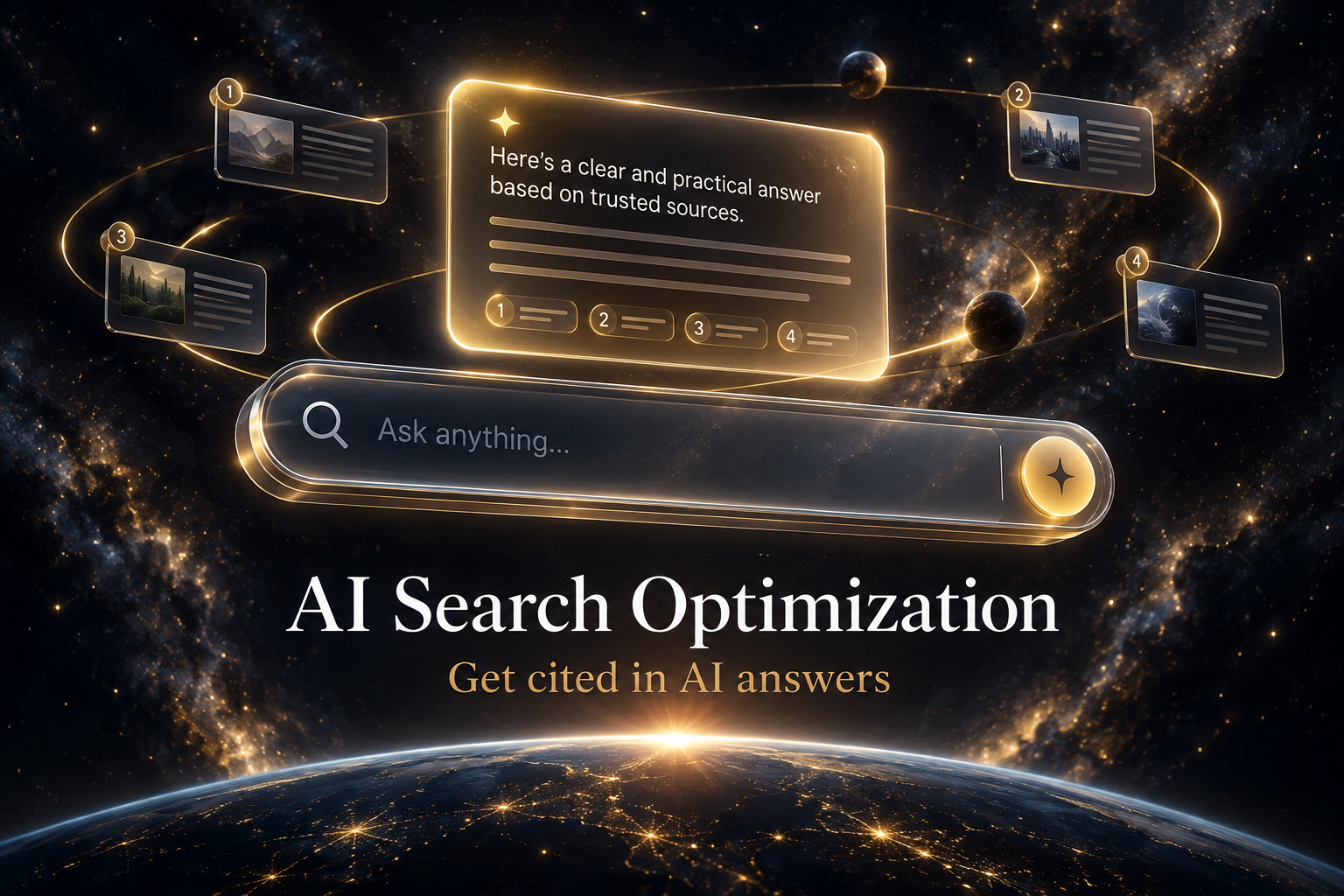
Ask ChatGPT, Gemini, Perplexity, or Google’s AI Overviews for “the best bookkeeper in Winnipeg” or “how to choose a web developer in Canada”, and you’ll get a neat, confident answer. Sometimes that answer mentions specific businesses. Sometimes it cites sources. The question every owner should be asking is simple: why not us? AI search is changing how people find businesses, and the companies that adapt early will have a real advantage.
The good news is that AI search optimization isn’t a mysterious new discipline. Most of it builds on good SEO and good content. But there are some important differences, and this guide covers them in plain language.
What is AI search?
AI search refers to tools that answer questions directly using large language models instead of, or alongside, a list of blue links. The main ones today are:
- Google AI Overviews and AI Mode, which show generated summaries at the top of many search results.
- ChatGPT search, which browses the web and cites sources in its answers.
- Perplexity, an answer engine built around citations.
- Microsoft Copilot and Gemini, which bring similar features into browsers, phones, and work tools.
These tools read web pages, pull out the most useful information, and combine it into one answer. Some link to their sources. Others simply mention brand names. Either way, being included is the new version of ranking on page one.
How AI search is different from traditional SEO
Traditional SEO is about getting a page to rank for a query so people click it. AI search optimization, sometimes called generative engine optimization or GEO, is about getting your business and your content used inside the answer itself.
A few differences matter in practice:
- Fewer clicks, more influence. People may read the AI answer and never visit a website. Being mentioned still shapes who they call.
- Passages beat pages. AI tools often lift a specific paragraph, list, or definition. Clear, self-contained sections are easier to use.
- Reputation travels. AI models learn about your business from reviews, directories, news, and forums, not just your own site.
- Specifics win. Vague marketing copy gives an AI nothing to quote. Concrete facts, prices, processes, and examples do.
The foundations still overlap heavily. Google says that the same best practices for regular search apply to its AI features. You can read its guidance on AI features and your website.
8 ways to show up in AI search results
1. Answer real questions clearly
List the questions customers ask before buying: cost, timelines, how to choose, what’s included, what can go wrong. Answer each one directly in the first sentence or two, then add detail. A page that opens with a straight answer is much easier for AI search tools to use than one that opens with three paragraphs of brand story.
2. Structure content so it’s easy to lift
Use descriptive headings, short paragraphs, bullet lists, and simple tables. Each section should make sense on its own. If someone copied just that one section into a chat, would it still be useful? That’s the test.
3. Be specific and original
Generic content is everywhere, and AI tools have already seen it a thousand times. Share what only you know: real price ranges, how your process works, results from projects, mistakes you see clients make, local details. Original information is what earns a citation.
4. Show who’s behind the content
Add author names, credentials, and real experience. Keep your About page detailed and current. Mention certifications, years in business, and the team. AI search tools, like Google, look for signs that content comes from people who know the subject.
5. Build your reputation off-site
AI models form an opinion of your business from what others say. Reviews on Google and industry sites, mentions in local news, listings in reputable directories, podcast appearances, and helpful answers in community forums all add up. This is where local SEO and AI search optimization overlap heavily.
6. Use structured data
Schema markup tells machines exactly what your content is: an organization, a local business, a service, an article, an FAQ, a product with a price. It won’t guarantee a mention, but it removes guesswork. SEO plugins like Rank Math handle much of this automatically when set up correctly.
7. Keep your site fast and crawlable
If AI crawlers can’t load your pages quickly, or if important content only appears after heavy scripts run, it may be missed. Check that your robots.txt isn’t accidentally blocking the crawlers you want, and keep key information in plain HTML text rather than inside images or PDFs.
8. Keep facts consistent everywhere
Your business name, services, locations, hours, and prices should match across your website, Google Business Profile, social profiles, and directories. Conflicting information makes AI tools less confident about recommending you.
What this means for different types of businesses
Local service businesses
For plumbers, dentists, lawyers, and other local providers, AI answers lean heavily on reviews, Google Business Profile details, and local directories. People asking for a recommendation usually get three to five names. The businesses with plenty of recent, detailed reviews and consistent information across the web tend to be the ones mentioned. Your website still matters, but your reputation off-site matters just as much.
Online stores
Shoppers increasingly ask AI tools to compare products, suggest gift ideas, or find something that meets specific needs. Detailed product descriptions, clear specifications, honest reviews, accurate pricing, and structured product data all make your products easier to recommend. Thin descriptions copied from the manufacturer give AI tools no reason to pick your store over the next one.
B2B and professional services
Buyers doing research before contacting a consultant, agency, or software company often start with a question like “how do I choose” or “what should this cost”. Honest, detailed guides that answer those questions position you as the expert. Case studies with real numbers, clear service pages, and a visible team with genuine experience all help AI tools, and human buyers, trust you.
Healthcare and regulated industries
AI tools tend to be more cautious with medical, legal, and financial topics, favouring sources with clear expertise and credentials. Make sure qualified professionals are named on your content, keep information accurate and dated, and link to official sources where appropriate.
Whatever your industry, the pattern is the same: be clear, be specific, be consistent, and be talked about. That’s how you earn a place in AI answers, and it happens to be how you win customers too.
What to avoid
- Mass-produced content. Publishing dozens of thin, AI-written pages rarely helps and can hurt how search engines see your whole site.
- Keyword stuffing. AI systems read for meaning. Repeating a phrase unnaturally makes content worse, not more visible.
- Chasing tricks. Hidden text or prompts aimed at AI crawlers may work briefly, then backfire. Trust takes a long time to rebuild.
- Ignoring your existing pages. Updating and strengthening pages you already have is often faster than creating new ones.
How to check whether you appear in AI search
There’s no perfect ranking report for AI answers yet, but you can build a useful picture:
- Write down ten to twenty questions a potential customer would ask, including local ones like “best accountant for small businesses in Surrey”.
- Ask them in ChatGPT, Gemini, Perplexity, and Google, and note whether your business or content appears, along with which competitors do.
- Repeat monthly. Answers change often, so look for trends rather than single results.
- Watch your analytics for referral traffic from AI tools, which usually shows up as visits from chatgpt.com, perplexity.ai, and similar sources.
When competitors keep appearing and you don’t, look at what they have that you lack: more reviews, clearer pages, more specific information, or more mentions on other sites.
A realistic 90-day AI search plan
Month 1: foundations
Fix technical basics, make sure your key pages load quickly, add structured data, and make your business details consistent everywhere. Tighten your About page and service pages so they clearly say who you help, where, and how.
Month 2: answer content
Create or improve pages that answer your customers’ most common questions, each with a direct answer up front. Add real examples, prices where you can, and a short FAQ section.
Month 3: reputation
Run a steady review request process, update directory listings, and look for opportunities to be quoted or featured by local media, associations, and industry sites.
After that, it becomes an ongoing habit, much like traditional SEO. Businesses that treat AI search as a one-time project usually drift back out of the answers.
AI search FAQ
Is traditional SEO dead?
No. Most AI search tools still rely on search indexes to find and verify information. Strong SEO is the foundation that AI visibility is built on.
Can I pay to appear in AI answers?
Some platforms are testing ads, but organic mentions come from being genuinely useful and well known. There’s no shortcut to being the answer.
How long does it take to see results?
Technical and content fixes can show up within weeks for some queries. Reputation building takes months, just like it does offline.
Want your business to show up in AI answers?
We’ll check how visible you are in AI search today, compare you to competitors, and build a practical plan to close the gap.